It’s 1983 when Bill Williams, a young American programmer, decides it’s time for a cat to enter a computer and video game history. At the time, videogames were mostly about spaceships, pixelated heroes and intergalactic battles. In the middle of all this, however, a small black cat managed to steal the scene.
Alley Cat, created by Bill Williams for Synapse Software, is a game of surprising freshness and charm. There are no planets to save, no princesses to rescue, although, to be fair, there is a love-struck little cat waiting at the end. The protagonist is Freddy, a stray who jumps across trash cans and apartment windows.
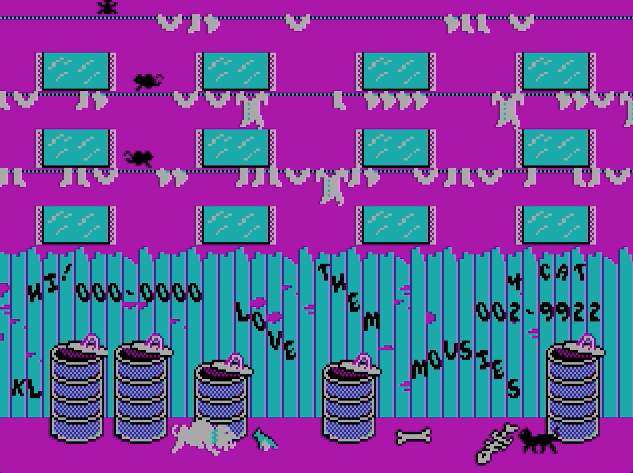
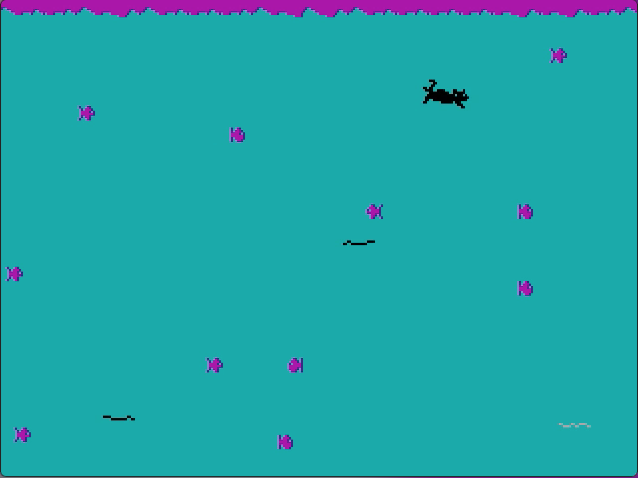
Back then, Atari 8-bit computers and the first IBM PCs had resources that would make us smile today: a handful of colours, minimal sound, and memory pared down to the bone. Yet Alley Cat is a small miracle, turning those very limits into its strength. Each window hides a micro-story: a living room to steal fish from, a room full of mice to chase, a bookshelf to climb. Every jump is a dare against gravity, against the landlord’s broom, against the trash tossed from windows above.
Williams, a programmer with a philosopher’s soul, transforms technical limitations into interactive poetry. His code, written for Atari 8-bit machines, moves lightly, just like his feline hero: dynamic, ironic, always flirting with risk. There was no space for graphical complexity at the time, but there was endless room for the player’s imagination. Williams used character-mapped graphics creatively, repeating and modifying small pixel blocks to simulate fluid animation: an almost artisanal technique that breathed life into a world surprisingly vivid and engaging.
And this is perhaps the real magic of Alley Cat: not just a game, but a portrait of independence, an ode to urban survival. At a time when videogames were mostly about power, Williams chose to tell a story about freedom.
A Small Classic with a Big Soul
Today, Alley Cat is considered “retro”, but it still feels remarkably fresh, not only because it anticipated the sense of movement and physicality that would appear years later in 3D games, but because it conveys something profoundly human through the adventures of a stray cat.
Alley Cat is a tribute to curiosity, adaptability, and independence. In a world of pixels and technical limits, it reminds us that true innovation comes from observation: from watching a cat leap onto a windowsill… and deciding to teach us how to do the same.
Remembering Bill Williams
Bill Williams was not a typical programmer. A self-taught musician, an intellectual, he had a poetic vision of computing. To him, a videogame was not just entertainment, it was a dialogue between human and machine, a form of art capable of telling stories even without words.
Williams lived with cystic fibrosis, a chronic condition that shaped both his life and his art. Perhaps for this reason, his games (Alley Cat, Necromancer, Sinbad and the Throne of the Falcon) always speak of resilience, freedom, and curiosity.
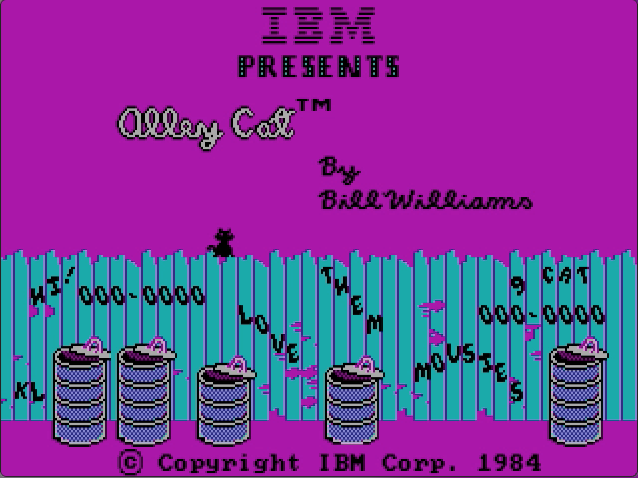
Freddy the stray cat feels like the alter ego of his creator: determined, slightly melancholic, yet always ready to attempt the impossible jump toward the next window.
Bill Williams died in 1998 at only 38. In one of his final interviews, he said he always tried to “create worlds that make you think, not just win.”
Today, when we look back at Alley Cat, we can still feel the gentleness and irony that made Williams’ programming style so unique. And although there’s no definitive source to confirm it, we like to imagine him working with a black cat in the room, curious, stubborn, climbing onto his desk during long programming sessions. The image of that cat next to the monitor, watching lines of code turn into feline movement, is simply too perfect not to be true.
Sources
- YAAM Magazine, February 1989 — Interview with Bill Williams (vgpavilion.com)
- Jimmy Maher, “Bill Williams: The Story of a Life,” The Digital Antiquarian (filfre.net)
- Technical sheets and archives on Atarimania and Archive.org
- Historical analysis on HardcoreGaming101 — Retro Feature: Alley Cat
- Synapse Software promotional materials (1982–1984)

0 Comments